The Relative Wear model
It is calculated based on the relative velocity and associated forces between the bulk material and the equipment. This model provides you with data to indicate regions in which wear is taking place. While it provides quantitative values for comparison between two or more design iterations, it does not determine an explicit material removal rate.
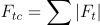
The four relative wear properties are Normal Cumulative Contact Energy, Tangential Cumulative Contact Energy, Normal Cumulative Force and Tangential Cumulative Force. Normal and Tangential Energy measure the cumulative energy due to material impacting and sliding respectively.

where Vnis the normal relative velocity and is negative in a loading situation.

where Vtis the tangential relative velocity.
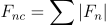
when
 less than 0.svg) and
and 
The Fnc is the cumulative peak forces of the different contacts occurring on a geometry element.
| Interaction | Configurable Parameters | Position |
| Particle to Particle | None | Last |
| Particle to Geometry | Record Relative Wear (On/Off).The Relative Wear model is a way of identifying regions of high impact (normal) and abrasive (tangential) wear on the equipment within a simulation. It is calculated based on the relative velocity and associated forces between the bulk material and the equipment. This model provides you with additional data to indicate regions in which wear is taking place. Whilst it provides quantitative values for comparison between two or more design iterations, it does not determine an explicit material removal rate. |
Last |
(c) 2023 Altair Engineering Inc. All Rights Reserved.